About the
Program
What
majors and minors are offered?
Why
should I major in Biochemistry & Molecular
Biology?
Why
should I choose the Biochemistry & Molecular
Biology program at Western?
What
type of graduate schools and programs
are your graduates attending?
What
are the admission requirements
for the program?
As
a high school student, how should
I prepare for a biology degree?
What
is the typical class size?
How
do students work together with
faculty?
What
student organizations are available?
What
type of awards have your faculty
and students received recently?
What
types of grants have your department
received?
Does
your department have any partnerships
with medical schools?
What
majors and minors are offered?
The
Bachelor of Science degrees in Biochemistry & Molecular
Biology prepare graduates for entry-level
work in the life sciences industry
or entry into graduate school.
Why
should I major in Biochemistry & Molecular
Biology?
Expectations are
high for new discoveries and new
industries in the life science field. Just
as the 20th century was the “Century
of Chemistry and Physics,” the
21st is predicted to be “The
Century of Biology.” Creative
people with a strong foundation in
the life sciences will be needed in
agriculture, pharmaceuticals, medicine,
environmental science and conservation.
The department has excellent
programs for entry-level positions
in all of these fields. It also provides
an outstanding foundation for entry
into graduate and advanced professional
schools. Students are encouraged to
critically evaluate information from
a diversity of fields and in this way
students become “critical thinkers,” capable
of succeeding in a variety of jobs.
Why
should I choose the Biochemistry & Molecular
Biology program at Western?
The Biology Department
boasts a biological chemistry lab that
contains $.5 million worth of equipment,
including a DNA Sequencer and synthesizer.
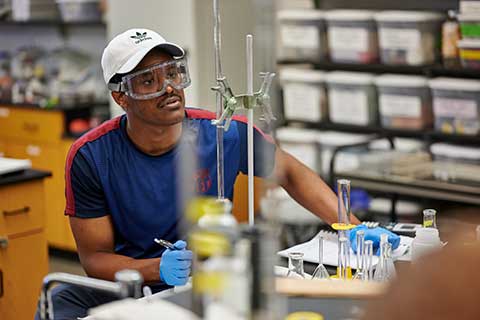
Students in the program gain extensive
hands-on experience in all labs through
class work and independent research,
as each year, the department is awarded
thousands of dollars in grants to support
student and faculty research. Professors
work very closely with students on
research projects, and a high percentage
of students present their findings
at professional meetings.
The professors are dedicated
to the students, and are outstanding
teachers and researchers. They have
professional ties with industry and
agencies that provide numerous career-networking
opportunities for students.
What
type of graduate schools and programs
are your graduates attending?
A
growing number of our graduates from
the Biochemistry & Molecular
Biology program go on to graduate and
advanced professional schools after
earning their bachelor’s degree.
Numerous Biology Department graduates
are enrolled in, or have completed,
masters or doctorate programs and many
others have completed or are working
on medical-oriented professional degrees
to become medical doctors, veterinarians
or dentists.
What
are the admission requirements for
the program?
The entrance requirements
are the same as those required by the
institution.
As
a high school student, how should
I prepare for a Biochemistry & Molecular
Biology degree?
High school students
who have completed the college-preparatory
curriculum including at least three
years of high school science, and mathematics
through advanced algebra, are best
prepared for the field of biology.
Students that are highly motivated
in biology and have a problem-solving
orientation are most likely to succeed.
What
is the typical class size?
Although first-semester
freshman biology class lectures are
large - 60 to 100 students - lab sections
typically have less than 24 students.
Upper division classes often have 10
to 20 students.
How
do students work together with faculty?
Students and faculty
work one-on-one during faculty-sponsored
internships and student research projects.
Faculty members also make every effort
to meet with students as they work
on projects, study for exams, and plan
their schedules during advisement sessions.
What
student organizations are available?
- Beta
Beta Beta Biological Honor Society
- Wildlife
Society
- Pre-Professional
Club
What
type of awards have your faculty
and students received?
Students and faculty
in several biology department program
have received awards recently:
-
Four biology students
from Western won awards for their
research presentations at the district
meeting of the Beta Beta Beta National
Biological Honor Society.
-
One faculty member
was awarded the Jesse Lee Meyers
Excellence in Teaching Award for
2004.
-
Our Student Chapter
of the Wildlife Society won the
Best Chapter Award in the central
states for 2004.
What
types of grants has your department
received recently?
The Biology Department
has received several grants in the
past three years for several of their
programs:
-
Grants from the Missouri
Department of Conservation totaling
$7,500.
-
Grants from the U.S.
Fish and Wildlife Service totaling
$10,000.
-
Grants from the National
Institutes of Health totaling $136,000.
-
Grants from the National
Science Foundation totaling $61,000.
-
Grants from the Environmental
Systems Research Institute totaling
$160,000.
-
One biology professor
helped to write, and two biology
faculty members were instructors,
on an $117,000 Coordinating Board
of Higher Education No Child Left
Behind Grant involving area secondary
science teachers.
Does
your department have any partnerships
with medical schools?
The department has formed
partnerships with two medical schools
in Missouri to offer early admission
to qualified Western Biology majors.
An agreement with the
Kirksville (Mo.) College of Osteopathic
Medicine allows two sophomores per
year a guaranteed seat upon graduation
from Western.
In an agreement with
the Kansas City University of Medicine
and Biosciences, up to two sophomores
each year may be selected to matriculate
there following their junior year at
Western. Students simultaneously complete
their first year of medical school
and earn a bachelor’s degree
from Western.
|