Bachelor of Science Degree in
Criminal Justice with choice of
the following emphases: Administration,
Corrections, Juvenile Delinquency,
Law Enforcement and/or Legal Studies
Associate of Science Degree in
Criminal Justice
Associate of Science Degree in
Legal Assistant
Minor in Criminal Justice
Minor in Legal Assistant
Certificate in Legal Assistant
Is the program accredited?
The Legal Studies program is approved by the American Bar Association.
We have the only ABA approved program at a public institution
in Missouri. Our Legal Assistant program is also a charter member
of the American Association for Paralegal Education. Paralegals
cannot practice law. Only attorneys, who are licensed in the
state by the Supreme Court, can practice law.
Currently there is no accrediting agency for criminal justice
programs.
As a high school student,
how should I prepare for a Criminal Justice or Legal Studies
degree? If you are interested in a Criminal Justice or Legal Studies
degree, you should complete the college core courses and work
to improve your writing skills.
Courses such as Speech, Sociology, Writing or Psychology offer
good preparation for Criminal Justice majors; and Writing, Speech
and Government classes, and classes that help develop cognitive
thinking, are helpful for Legal Studies majors.
Are there opportunities
for travel study?
Yes. Students have the opportunity to travel to Washington,
DC as part of the Current Legal Issues course.
What is the typical
class size? Class sizes for upper level majors courses average 25 students.
Students receive a great deal of personal attention, and every
full-time faculty member serves as an academic advisor for our
students. Faculty members also make themselves accessible to
students during their regular weekly office hours and by appointment.
In what ways do faculty
and students work together? All students complete an independent research project under
the direction of a faculty member in LAW 420-Senior Research
Students may work with professors on grant projects, also,
such as The Study of Deinstitutionalization of Status Offenders,
and Restorative Justice.
Has the department received
any grants? In the past two years, the department
has received four grants totaling $168,000. Three were research
grants relating to restorative justice, and a fourth was for
a research project entitled, “Deinstitutionalization
of Status Offenders.” Criminal Justice students assisted
faculty on all four grants.
What are some of the
student accomplishments in your department? In January 2005, Andrew Weeden and LeeAnn Fann, two
senior Criminal Justice/Legal Studies majors at Missouri Western,
presented research poster sessions at the American Corrections
Association Annual Winter Conference in Phoenix, Arizona. Andrew
presented results of his research on the fear of flying commercial
airlines in the wake of September 11th, 2001. LeeAnn's research
was on the effectiveness of state program's dealing with child
support. Andrew won First Place in the undergraduate division.
Members of Delta Phi Epsilon, MWSU student chapter of the American
Criminal Justice Association -- Lambda Alpha Epsilon, compete
every year at ACJA-LAE regional and national competitions. Our
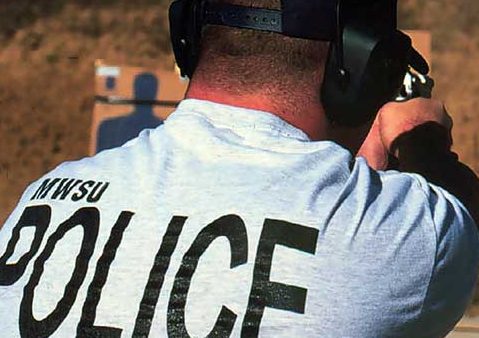
students often win awards in crime scene, written, firearms
and other areas.
What are some of your
faculty members’ accomplishments? One faculty member worked with the Department of Chemistry
to create a Bachelor of Science degree in Forensic Science,
which has proven to be a rapidly growing, very successful degree
program. He also worked with the Southern Institute of Forensic
Science to offer courses on campus, such as Basic Forensic Anthropology
for Law Enforcement & Death Investigators, Basic Forensic
Pathology, Blood Spatter Pattern Analysis, and Human Skeletal
Remains.
Criminal Justice and Legal Studies Department faculty members
are contacted on a regular basis to serve as consultants for
the St. Joseph Police Department, the Buchanan County Juvenile
Office, and the Law Enforcement Center, as well as in drug courts,
mediation, and for drafting of state legislation. One professor
is often called upon by local law enforcement agencies to aid
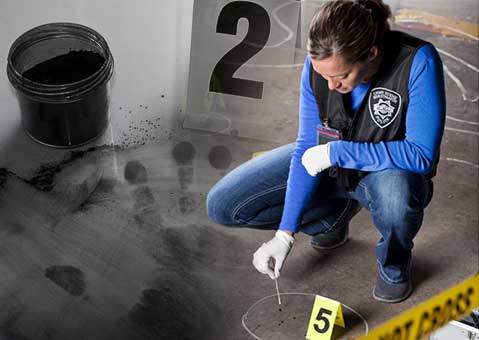
in the analysis of case evidence, GPS mapping of crime scenes
and in the processing of crime scene photographs.
One professor has served 14 years on the governor-appointed
state Child Abuse and Neglect Review Board, while another currently
serves on the governor-appointed Juvenile Justice Advisory Group.
What types of facilities
are offered?
All classes are taught in “smart classrooms,” which
are equipped with computers, Internet,
video, and other state-of-the-art media presentation equipment.
There is also a Criminalistics Lab and a Photography Lab for
students enrolled in Police Photography and Criminalistics courses.
What student organizations
are offered? Students may choose one or both of two
student organizations in the department: Delta Phi Upsilon,
student chapter of the American Criminal Justice Association-Lambda
Alpha Epsilon, and the Missouri Western Legal Studies Association.
Delta Phi Upsilon is affiliated with the national association
that supports education and training
in the area of criminal justice.
Students have the opportunity to attend regional and national
conferences, where they can compete in written tests, mock crime
scenes, firearms, and physical agility. There is also a national
student paper competition and scholarship paper competition
for recognition and publication. Missouri Western students have done
well in competitions each year, as evidenced by the trophy case
in the department. They also
participate in campus and community
activities.
The Legal Studies Association participates in community service,
campus activities, and networking within the legal community.
For more information about the Legal Studies Association, please
contact Suzanne Kissock at (816) 271-4454.
How does the department
interact with the community? Student organizations participate in local highway clean up,
Habitat for Humanity and tutoring at the Salvation Army. The
Legal Studies Association, in conjunction with the LAW 310-Legal
Drafting class, offers a Pro Se Divorce clinic through Legal
Aid of Western Missouri.
All faculty members in the department serve on local, county
and state boards or committees, and they are involved in both
community and professional organizations such as the Buchanan
County Law Enforcement Center Board, Buchanan County CASA, Buchanan
County Juvenile Drug Court, Northwest Missouri Child Advocacy Center, Legal Aid of Western Missouri, St.
Joseph Bar Association, Juvenile Justice Advisory Group, Missouri Bar Association, Crime Stoppers
and Enough Abuse.
Faculty members have done fingerprinting
for community agencies, and one faculty member is often called
upon by local law enforcement agencies to aid in the analysis
of case evidence, GPS mapping of crime scenes and in the processing
of crime scene
photographs.
Does the department accept transfer credit?
Students who have taken paralegal courses at other institutions may petition to the Department Chair to have courses transferred into Missouri Western State University. No more than nine credit hours of legal specialty classes will be accepted as transfer credit. The student must include with the petition a catalog from the institution, course syllabi, a transcript, and sample work from the legal specialty courses. Transferability is based on the approval by the American Bar Association of the program, comparability of the course, including evaluation of practical assignments, year course was taken, and grade the student received. Transfer from schools that are not ABA approved will be considered on a course by course basis, as long as academic quality and comparability to Missouri Western State University courses exists. Courses over seven years old will not be transferred into the program.
4525 Downs Dr., St. Joseph, MO 64507 PH: 816-271-4200
Copyright
| An equal opportunity/affirmative action institution.